Articles — Page 3
Below is a collection of assorted writings, a lot of them are from my old blog, "Absolutely No Machete Juggling." Most of the posts are about technology and programming, but odds are you landed here because I once wrote a very long post about Star Wars and it blew up like the second Death Star.
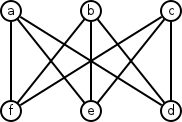
Why The Complete Bipartite Graph K3,3 Is Not Planar
The graphs \(K_5\) and \(K_{3,3}\) are two of the most important graphs within the subject of planarity in graph theory. Kuratowski’s theorem tells us that, if we can find a subgraph in any graph that is homeomorphic to \(K_5\) or \(K_{3,3}\), then the graph is not planar, meaning it’s not possible for the edges to be redrawn such that they are none overlapping.
I Broke Your Code, And It's Your Fault
One of the most enjoyable parts of my last job was that we hired a lot of junior developers and interns. I really enjoy working with younger people than me, because they’re as eager to learn new things as I am. I also really enjoy discussing technical things with them, largely for selfish reasons: explaining something to someone else makes me understand that thing much better.
Magic Variables Aren't Always Magic
Software development is a strange beast sometimes. Despite the fact that it is not predictable enough or constant enough to qualify as true engineering, it’s often referred to as Software Engineering anyway.

Mechanics of Good Pairing
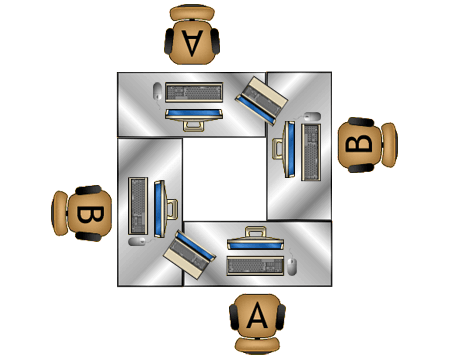
I’ve made no secret about the fact that I Love Pair-Programming. I’ve tried pair programming with a number of different setups, each one better than the last.
What Is Technical Debt?
Paul Dyson has made a blog post entitled “Technical Debt and the Lean Startup” as well as commented on my post about When To Work On Technical Debt, challenging some of my claims. I read through his post and, while it makes a number of good points, I think it ultimately advocates for a risky manner of running a business. I started typing this as a response to his comment, but realized that it was long enough to warrant a separate post, so I’d like to go through his post’s points one by one.
When To Work On Technical Debt
I hear the same complaints and concerns from all sorts of different software development organizations. It seems that development teams only suffer from a small handful of problems in the broad sense, and nearly every team seems to share them.
A Different Kind of Technical Interview
Everyone who’s been programming professionally for a while knows the standard format of the technical interview. You go in, there’s a whiteboard in the room, and you write code on it to answer questions.